Week 1: the sounds English does not have
- The g and ch. Goed, graag, acht. The sound is made at the back of the throat, like clearing it gently. In the north of the Netherlands it is hard and scraping; in the south and in Flanders it is soft. Both are correct.
- Ui and eu. Huis, uit, buiten; neus, leuk, deur. Neither sound exists in English. Start from the Dutch u, say it with the mouth a little more open for ui, and a little more closed for eu.
- Ij and ei. Two spellings, one sound: ijs, mijn, ei, klein. It is close to the vowel in the English word day.
- Long and short vowels. Man and maan, bot and boot, vis and vies are different words. The spelling tells you: a doubled vowel, or a single vowel at the end of a syllable, is long.
- The r and the w. The r is rolled, made in the throat, or close to an American r at the end of a word, depending on the speaker. The w is softer than in English, between a w and a v.
Week 2: the words you already know
English and Dutch grew from the same root, so you start with a large vocabulary: water, huis, boek, appel, melk, brood, goed, hand, arm, open, warm, winter. Say them the Dutch way, with Dutch vowels, and they are Dutch. A few look familiar and mean something else: slim is clever, brutaal is cheeky, and eventueel means possibly, not eventually.
Learn every noun with its article. Dutch has two: de for most nouns and het for the rest. Which one a noun takes is hard to predict, so it is easier to learn de huis or het huis as one word than to fix it later; it is het huis.
Numbers are said backwards from twenty: eenentwintig is one-and-twenty, and drieënveertig is three-and-forty. Give them an hour on their own.
Week 3: the verb in the right place
Dutch verbs are light. In the present you need three forms: ik werk, jij werkt, wij werken. For the past of conversation, use hebben or zijn with a participle: ik heb gewerkt, ik ben gegaan. For the future, the present tense with a time word is enough: ik werk morgen.
The place of the verb is the real grammar of Dutch. In a main clause it stands second, whatever comes first: Morgen kom ik. After words such as dat, omdat and als it moves to the end: Ik denk dat hij morgen komt. Some verbs split, and a piece goes to the end on its own: opbellen becomes ik bel je morgen op. Learn these as sentence frames you say out loud, not as rules.
Week 4: keep the conversation in Dutch
Dutch speakers switch to English the moment they hear an accent. They mean well, and it is the main reason learners stall. Have one sentence ready and use it every time: Mag ik Nederlands oefenen? May I practise Dutch? Most people will smile and slow down.
Decide early between Netherlands Dutch and Flemish. The written language is the same; Flemish has the soft g and a rolled r, uses u more often, and in conversation you will hear ge and gij for you. Choose the one you will use and learn that first.
Then put it to use. Een koffie, alstublieft. Dank je wel. Dutch adds the ending je to almost anything to make it small and friendly, so you will hear koffietje and biertje more often than koffie and bier.
A daily routine that fits in five minutes
- One sound for the week. Start with the g, then ui and eu, then long against short vowels.
- One short drill. A few phrases built around that sound. Say them, listen to what shifted, say them again.
- One sentence frame. One main clause and one clause with dat, said out loud with different verbs.
- Every day. The g is a muscle movement, and the verb at the end is a habit. Both come from repetition.
How Mimica fits this plan
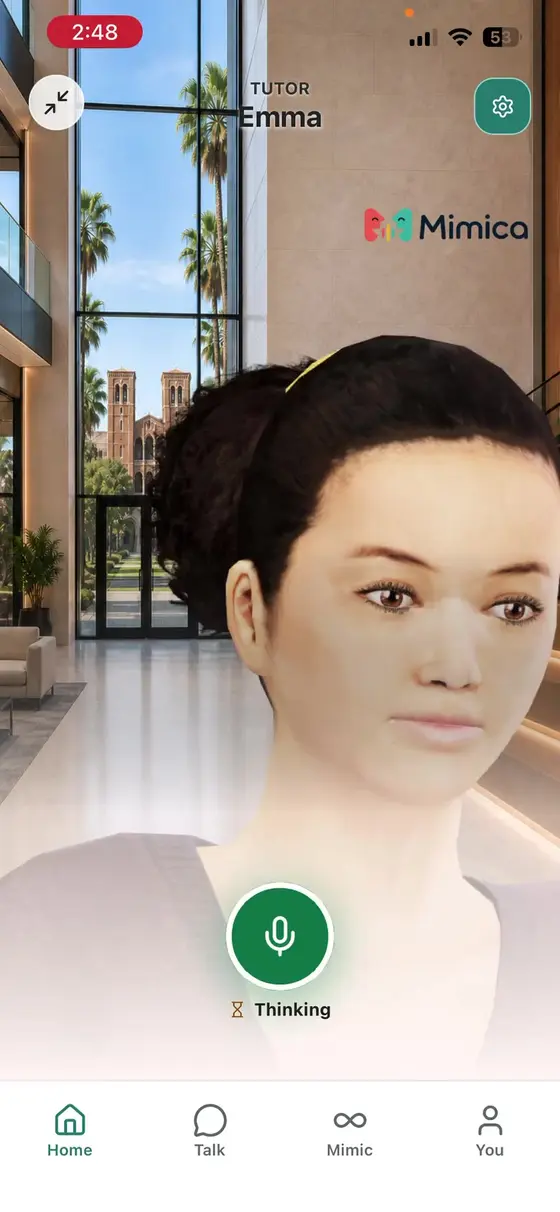
Mimica is an app for iOS and Android built around speaking out loud. You talk with AI tutors and characters, play roleplay scenes with a goal, and drill pronunciation phrase by phrase, with subtitles and instant translation in your own language whenever you need them. The tutor adapts to the level you chose during setup, and it never switches to English on you. The Free plan gives you five minutes of speaking a day.