What is easy
- Shared vocabulary. Water, huis, boek, appel, melk, brood, goed, hand, open, warm. Thousands of everyday words are the same or nearly the same, because English and Dutch grew from the same root.
- Light verbs. Three forms in the present, ik werk, jij werkt, wij werken, and one pattern for the past of conversation, ik heb gewerkt.
- No cases. Unlike German, nouns and articles do not change with their role in the sentence. There are two genders, not three.
- Regular spelling. Once you know the rule for long and short vowels, you can read any word aloud.
- Input with subtitles. Films and series in the Netherlands are subtitled rather than dubbed, so Dutch listeners are used to reading along, and so can you.
What takes time
- The sounds. The g and ch at the back of the throat, the vowels ui and eu, and the difference between man and maan or bot and boot.
- De and het. Every noun takes one of the two, and the adjective ending depends on it: een groot huis but het grote huis.
- Word order. The verb stands second in a main clause, goes to the end after words such as dat and omdat, and some verbs split, sending a piece to the end on its own. You learn to wait for the end of the sentence.
- The small words. Er has half a dozen uses, and words such as even, maar, toch and wel change the tone of a sentence without changing its meaning. They come with time and listening.
- Two standards. Netherlands Dutch and Flemish differ in sound and in some everyday words. Everyone understands everyone, but you choose one to learn first.
- The switch to English. Dutch speakers answer an accent in English, out of politeness. Learners who do not insist on Dutch can live in the Netherlands for years without speaking it.
It depends on your first language
- German. The grammar and the vocabulary are close, the word order is the same, and there are no cases to learn. German speakers learn Dutch faster than anyone except Afrikaans speakers, for whom it is almost free.
- English. The vocabulary and the past tense feel familiar. Word order, de and het, and the g are the work.
- Swedish, Danish, Norwegian. The verb-second word order and much of the vocabulary are familiar. The g and the vowels are new.
- French, Spanish, Portuguese, Italian. The g, the vowels, the consonant clusters at the start of words such as schrijven, and the word order are all new. The grammar is still lighter than at home.
- Japanese, Korean, Chinese. Consonant clusters, the g, two genders and the moving verb take time, but there are no tones and no new script.
How long it takes
The US Foreign Service Institute, which trains diplomats, puts Dutch in its easiest group for English speakers: about 24 weeks of full-time study, around 600 class hours, to reach professional working proficiency. Everyday conversation comes much sooner, as long as the conversation stays in Dutch.
What makes it easier
- Learn the g and the vowels in the first two weeks, before anything else.
- Learn every noun with de or het, as one word.
- Practise sentence frames out loud: one main clause, one clause with dat.
- Ask people to stay in Dutch, every time, with one ready sentence.
- Speak a few minutes every day. The g is a muscle movement and the word order is a habit.
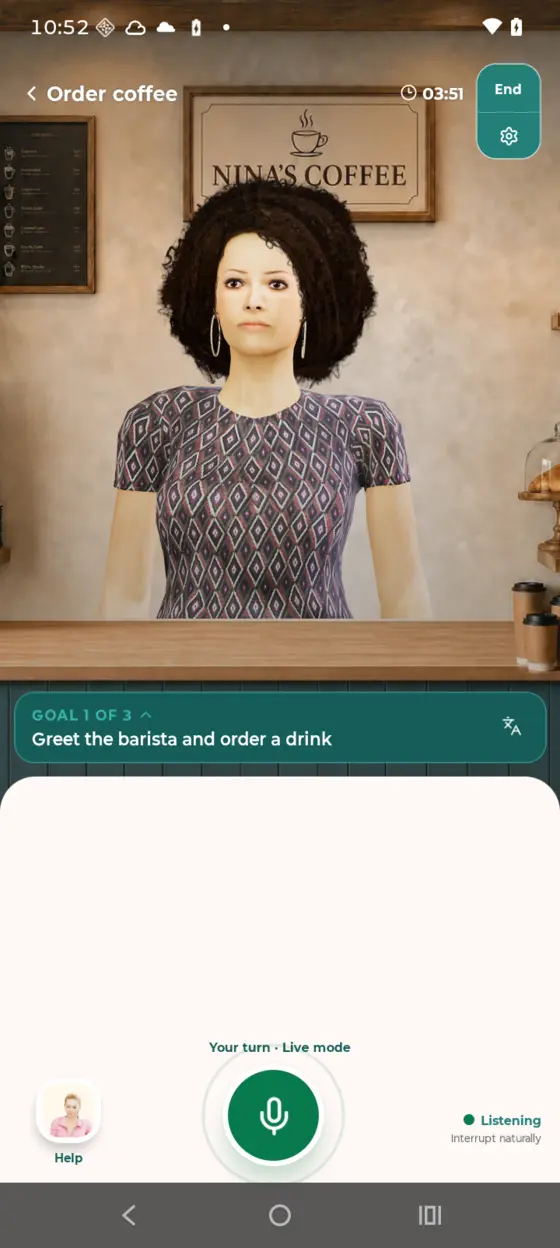
Mimica is an app for iOS and Android built around speaking out loud. You talk with AI tutors and characters, play roleplay scenes with a goal, and drill pronunciation phrase by phrase, with subtitles and translation in your own language. See how to learn Dutch, the closest language to English for a first-month plan.