Week 1: learn the sounds, not the letters
English spelling does not tell you how a word sounds. The words though, through, tough and cough share the same four letters and end in four different ways. So start with the sounds. English has around twenty vowel sounds, depending on the accent, while most languages have between five and ten. The vowels are where most learners are misunderstood.
In the first week, learn to hear and say the pairs that your own language does not separate: ship and sheep, full and fool, bad and bed. Add the two th sounds, as in think and this, and the English r. Say each pair out loud, record yourself, and compare the two recordings. The first one always sounds worse than you expected, and the fifth one sounds much better.
Week 2: the words you will actually say
You do not need a long list of words. You need the words for the situations you will be in: ordering food, introducing yourself, asking for directions, saying what you do and where you are from. A few hundred words cover these conversations. Learn each one by saying it inside a sentence, not by reading it on a card. A word you have only read is often a word you cannot find when someone is waiting for your answer.
Week 3: short sentences in a real conversation
English grammar is lighter than most. Verbs change very little, nouns have no gender, and adjectives never change. In the third week, work on four patterns: the present (I work, she works), the past (I worked, I went), the future with going to, and can for ability and requests. That is enough for most everyday conversations.
The hard part is not the rules. It is producing them at speed while someone is listening. So practise in a conversation where someone answers you, and keep your sentences short. A short sentence said clearly beats a long one that falls apart in the middle.
Week 4: rhythm and stress
English is a stress-timed language. The stressed syllables come at a fairly even beat, and the syllables between them shrink to a short, weak sound. In the word banana, only the middle syllable is strong. In the sentence "I can do it", the word can is usually so short that it almost disappears.
Word stress also carries meaning. REcord is a noun and reCORD is a verb. Putting the stress on the wrong syllable hurts understanding more than any single consonant, because the listener is searching for the beat. Practise by tapping the table on the strong syllable while you say the word.
A daily routine that fits in five minutes
- Choose one sound for the week. Three sounds in a month is better than seven at the same time.
- Drill it in a few phrases. Say the phrase, listen to what shifted, say it again.
- Use it in a conversation the same day. If you can make a sound in a drill but not in a sentence, it is not yours yet.
- Practise at a time when you are alone. Many people skip speaking practice because they feel someone can hear them.
Know where you stand
Most people guess wrong about their own accent. Accent Sherlock is a free test: you read a short passage aloud for about twenty seconds, and it places your English accent on a world map with a confidence level. It tells you which patterns in your speech are strong enough for a machine to notice, which is close to what a listener notices. Take it once a month to see what has changed.
How Mimica fits this plan
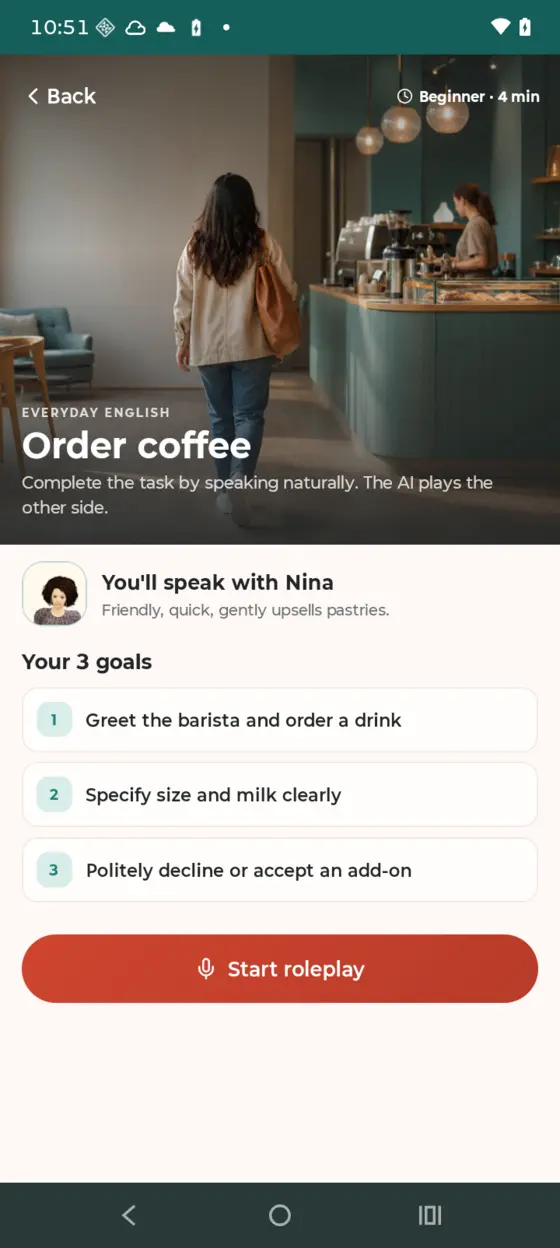
Mimica is an app for iOS and Android where you practise English out loud. You talk with AI tutors and characters, play roleplay scenes with a goal, such as ordering at a café, a job interview or a visit to the doctor, and drill pronunciation phrase by phrase. Mimic practice shows you which sounds shifted and plays the phrase back in a clearer version of your own voice. Subtitles and instant translation are there in your own language whenever you need them. The Free plan gives you five minutes of speaking a day, which is enough for one drill and one short scene.