What is easy
- Verbs barely change. I speak, you speak, we speak, they speak, and only he or she speaks gets an s. Spanish has six forms for every tense.
- No gender, no cases. A table is not feminine or masculine, and nouns and adjectives do not change their endings depending on their role in the sentence.
- Questions and negatives follow one pattern. Do you know? I do not know. One helper verb does most of the work.
- You already know thousands of words. Information, important, restaurant, university and many more came into English from French and Latin, so speakers of Romance languages can read a lot before they can speak.
- It is everywhere. Films, music, games and most of the internet give you more listening practice than any other language.
What takes time
- Spelling and sound do not match. The letters ough are read in at least six different ways. You have to learn the sound of each word separately from its spelling.
- The vowels. English has around twenty vowel sounds, depending on the accent. Most languages have five to ten. Ship and sheep, bad and bed, full and fool are different words, and listeners do hear the difference.
- A few consonants that few languages have. The two th sounds in think and this, the English r, and the difference between v and w.
- Rhythm. Stressed syllables are long and the others shrink. "What do you want to do?" comes out as something like "whaddaya wanna do" in normal speech. This is why listening feels harder than reading for a long time.
- Phrasal verbs. Get up, get over, get on with and get away with have little to do with each other, and there are hundreds of them.
- Articles and prepositions. A, an and the are hard for speakers of languages without articles, and in, on and at follow convention more than logic.
It depends on your first language
- Spanish, Portuguese, Italian. The vocabulary helps a lot. The work is in the vowels, the final consonants, the th sounds and, for Spanish speakers, b and v.
- French. Shared vocabulary again. The th sounds, the h, and word stress take time, because French stresses the end of the phrase rather than a syllable in each word.
- German, Dutch, Scandinavian languages. The grammar and many words are close. The usual work is w against v, the th sounds, and keeping final consonants voiced, so that bad does not become bat.
- Japanese, Korean. R and l, consonant clusters such as str in strength, articles, and a word order with the verb in the middle instead of at the end.
- Chinese, Vietnamese, Thai. Final consonants, the endings that mark past and plural, articles, and the move from tones to word stress.
- Arabic, Hindi, Urdu, Russian, Turkish. Each has its own short list: p against b for Arabic, v against w for Hindi and Urdu, articles for Russian and Turkish, and the th sounds for all of them.
How long it takes
There is no single number, because it depends on your first language and on how much of your study time is spent speaking. Most learners can handle everyday situations after a few months of daily speaking practice. Clear, confident speech in work situations takes longer, and it depends more on how often you speak than on how many years you have studied.
What makes it easier
- Speak from the first week, even with ten words. Reading about a sound does not train the muscles that make it.
- Work on one sound at a time, and start with the ones your first language does not have. The free Accent Sherlock test tells you which patterns are strong in your speech.
- Learn word stress with every new word. It matters more than any single consonant.
- Practise a few minutes every day rather than an hour once a week. A new mouth movement needs to be repeated often.
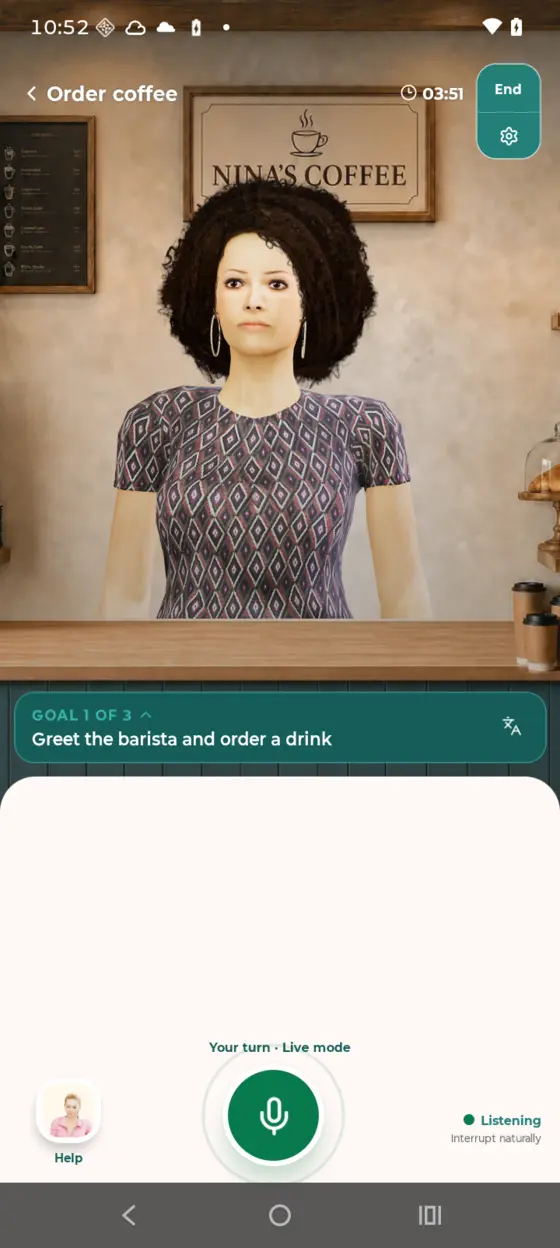
Mimica is built for exactly this. You speak English out loud with AI tutors and characters, play scenes with a goal, and drill pronunciation phrase by phrase with feedback on the sounds that shifted. In English, the app also plays your sentence back in a clearer version of your own voice, so the target sounds reachable. See how to learn English by speaking for a first-month plan.