Days 1 and 2: Hangul
Hangul was created in 1443 under King Sejong so that ordinary people could read. It has 14 basic consonants and 10 basic vowels, and the letters are grouped into syllable blocks: 한 is h, a and n in one block. The shapes of the consonants follow the mouth. ㄱ shows the tongue touching the back of the mouth, and ㅁ shows closed lips. You can learn to read it in a weekend. Stop using romanised Korean as soon as you can, because it hides the sounds you need to hear.
Week 1: the sounds
- Three kinds of consonants. Korean has plain, aspirated and tense versions of several consonants: ㄱ, ㅋ and ㄲ, or ㅂ, ㅍ and ㅃ. 불, 풀 and 뿔 are fire, grass and horn. The aspirated one has a puff of air; the tense one is made with a tight throat and no puff. English has only one of the three.
- Vowels. ㅓ and ㅗ are two different o sounds, and ㅡ is a sound made with the lips flat, as if saying oo without rounding them. ㅐ and ㅔ sound the same for most speakers today.
- No f, v or z. Coffee is 커피, keopi, and bus is 버스, beoseu.
- The final consonant. A consonant at the bottom of a syllable block changes sound depending on what follows. 한국어 is read "hangugeo" because the final consonant moves to the next syllable, and 합니다 is read "hamnida" because the b becomes an m before an n. Learn these changes by ear, from whole words.
Week 2: the yo form
The verb ends the sentence, and for polite everyday speech it ends in 요. 가다, to go, becomes 가요; 먹다, to eat, becomes 먹어요; 하다, to do, becomes 해요. The same form works for a statement and a question, with only your voice changing. The past adds 았어요 or 었어요: 갔어요, 먹었어요. For plans, use ㄹ 거예요: 갈 거예요, I will go. The formal form in 습니다 and ㅂ니다 is for announcements, customers and business.
Particles mark the role of each word: 은 and 는 for the topic, 이 and 가 for the subject, 을 and 를 for the object, 에 for a place you go to or a time, and 에서 for the place where something happens. Learn each one in a phrase you say.
Week 3: numbers and situations
Korean has two sets of numbers. The native set, 하나, 둘, 셋, is used for counting things, hours and ages. The set of Chinese origin, 일, 이, 삼, is used for money, dates, minutes and phone numbers. Things are counted with a counter: 개 for objects, 명 for people, 잔 for cups. 커피 두 잔 주세요 is two coffees please, and 둘 becomes 두 before a counter.
Then use it. Order at a café, introduce yourself at work with 저는 followed by your name and 입니다, and 만나서 반갑습니다, nice to meet you. One goal, one conversation.
Week 4: speech levels, and listening
Korean changes the verb ending depending on who you are talking to. Casual speech is for close friends and younger people, the yo form is for most people, and the formal form is for customers and superiors. When you talk about someone you respect, the verb takes 시: 가세요 instead of 가요. Start with the yo form everywhere. It is never rude.
Listening is the work of the fourth week. Korean drops the subject when the context makes it clear, the sentence ends with the verb, and the grammar lives in the endings. Listen to the end of the sentence before you answer.
A daily routine that fits in five minutes
- One sound for the week. Start with the three kinds of consonants, then ㅓ against ㅗ, then the final consonants.
- One short drill. A few phrases built around that sound. Say them, listen to what shifted, say them again.
- One short scene. One goal, one conversation, with someone answering you.
- Every day. A tense consonant is a muscle movement, and it needs repetition more than explanation.
How Mimica fits this plan
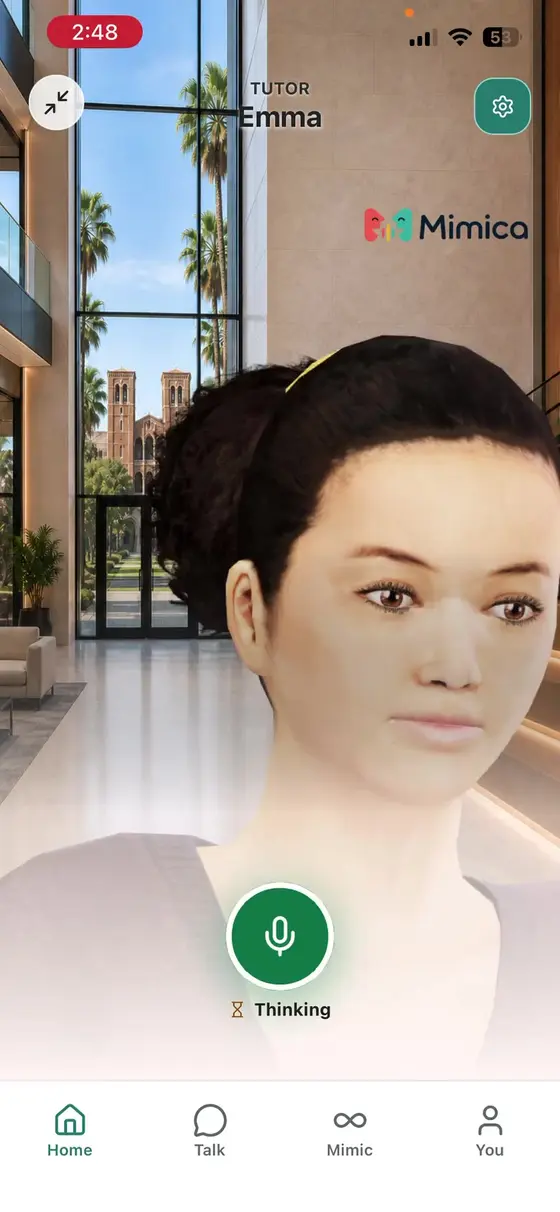
Mimica is an app for iOS and Android where you speak Korean out loud with AI tutors and characters. You play roleplay scenes with a goal, such as ordering at a café in Seoul or introducing yourself at work, the tutor speaks first and waits for your answer, and it adapts to the level you chose during setup. Mimic practice works phrase by phrase and shows you which sounds shifted. Subtitles and instant translation are there in your own language whenever you need them. The Free plan gives you five minutes of speaking a day.