What is easy
- Hangul. An alphabet designed in the fifteenth century to be learned quickly: 14 basic consonants, 10 basic vowels, and letter shapes that follow the mouth. Most people read it after a weekend.
- No gender, no articles, no agreement. Nouns do not change, the plural is optional, and the verb does not change for the person.
- Spelling. It follows the sound, with a set of regular changes at the end of syllables.
- Questions. In the polite form, a statement becomes a question just by raising your voice.
- Loanwords and input. Coffee, bus and computer are 커피, 버스 and 컴퓨터, and Korean series and music give you more listening material than most languages.
What takes time
- Three kinds of consonants. Plain, aspirated and tense: 불, 풀 and 뿔 are fire, grass and horn. English has one of the three, and hearing the difference takes weeks.
- Vowels and final consonants. ㅓ against ㅗ, the flat ㅡ, and a final consonant that changes sound depending on the next syllable, so 같이 is read "gachi" and 학년 is read "hangnyeon".
- Verb endings. Hundreds of endings combine tense, politeness, mood and the link to the next sentence. The ending decides the meaning, and it comes last.
- Speech levels and honorifics. The ending changes with the person you are talking to, and the verb changes again for the person you are talking about.
- Word order. Subject, object, verb, with descriptions before the noun. You wait for the end of the sentence to know what happened.
- Two number systems and counters. Native numbers for hours and counting things, numbers of Chinese origin for money and dates, and a counter for each kind of thing.
- Vocabulary. More than half of Korean words come from Chinese roots, and almost none are shared with European languages. Many words sound alike.
It depends on your first language
- Japanese. The grammar is almost parallel, with the verb last, particles and politeness levels, and many words of Chinese origin are shared. Japanese speakers learn Korean faster than anyone else.
- Chinese. The Sino-Korean vocabulary is often recognisable by sound. The grammar, the endings and the alphabet are new.
- Turkish, Mongolian. The word order and the way endings stack on the verb feel familiar.
- English, Spanish, French, Portuguese. Everything except the alphabet is new. Korean has no f, v or z, and one sound where English has r and l, so pronunciation takes practice in both directions.
How long it takes
The US Foreign Service Institute, which trains diplomats, puts Korean in its most demanding group for English speakers: about 88 weeks of full-time study, around 2,200 class hours, to reach professional working proficiency. Everyday conversation comes much sooner, especially if you speak from the first week instead of studying endings on paper.
What makes it easier
- Learn Hangul first and drop romanisation. It hides the sounds you need.
- Speak in the yo form with everyone. It is polite, regular and never rude.
- Learn endings as whole phrases you say, not as a table.
- Drill the pairs that matter: 불, 풀 and 뿔; ㅓ and ㅗ.
- Practise a few minutes every day. A tense consonant is a muscle movement.
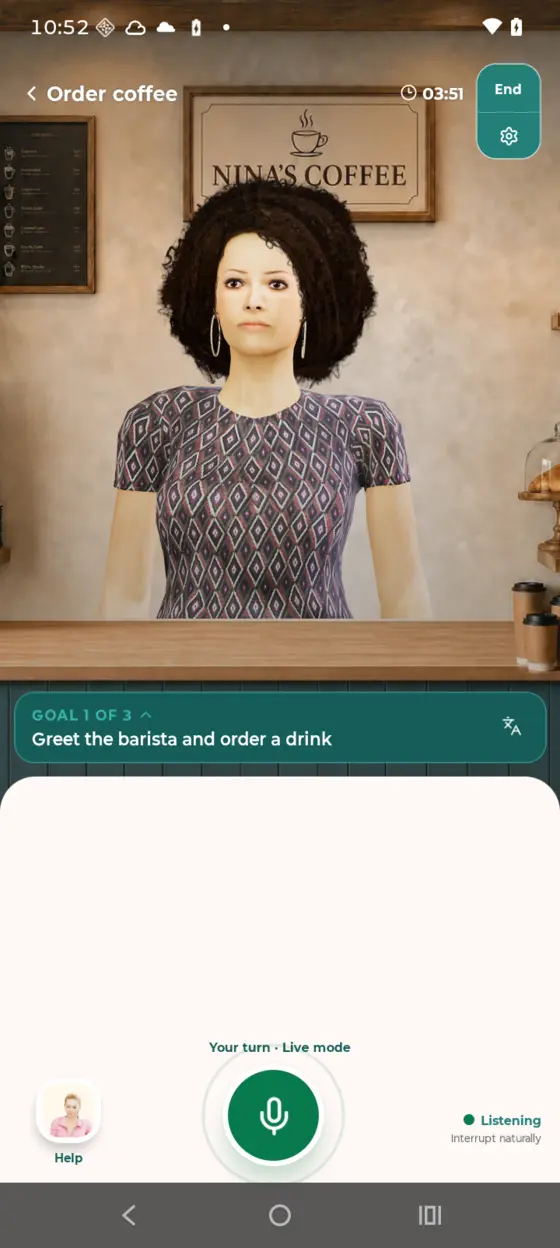
Mimica is an app for iOS and Android where you speak Korean out loud with AI tutors and characters. The tutor speaks first and waits for you, the scenes have a goal, such as a café in Seoul or introducing yourself at work, and Mimic practice shows you which sounds shifted, phrase by phrase. Subtitles and translation are there in your own language. See how to learn Korean, Hangul in a weekend for a first-month plan.