First, choose: Brazil or Portugal
The written language is the same, with small spelling differences, but the sound and some everyday words are not. A train is trem in Brazil and comboio in Portugal; a bus is ônibus and autocarro. Brazilian Portuguese is open and full of clear vowels. European Portuguese shortens its unstressed vowels and turns an s at the end of a syllable into a sh sound, so it sounds faster and more closed.
Most speakers are in Brazil, which has over two hundred million of the roughly two hundred and sixty million Portuguese speakers. Mimica's Portuguese tutors speak Brazilian Portuguese. Choose one variety and stay with it for the first months.
Weeks 1 and 2: the sounds
- Nasal vowels. The ã of maçã and irmã, the ão of não and pão, the õe of põe, and the endings em and im as in bem and sim. The air goes through the nose and there is no n or m sound at the end.
- Open and closed e and o. Avó with an open o is grandmother; avô with a closed o is grandfather. The written accents tell you which one: the acute accent is open and the circumflex is closed.
- The r. At the start of a word or written rr, it sounds like an h in most of Brazil: Rio, carro. Between vowels it is a quick tap: caro.
- Brazilian habits. T and d before an i sound like ch and j, so dia, tarde and leite come out as "jia", "tarji" and "leichi". An l at the end of a syllable sounds like w, so Brasil ends in "iw". A final o sounds like u and a final e like i.
- Unstressed syllables shrink. Listen for the stressed syllable in each word and let the others be short.
Week 3: the verbs you will use
In Brazil, you is você, and it takes the same verb form as he and she: você fala, ele fala. That means fewer endings to learn at the start than in Spanish. Portugal, and some parts of Brazil, use tu with its own form.
Learn the verbs of every conversation: ser and estar for to be, ficar for to stay, to become and to be located, which Brazilians use constantly, and ter, ir, fazer, querer and poder. For the future, use ir plus the verb: vou comer. For the past, learn the pretérito perfeito of your most common verbs: falei, comi, fui. In Brazil, I am speaking is estou falando; in Portugal it is estou a falar.
Week 4: words and conversation
English speakers already know many words. Information is informação, city is cidade, and possible is possível. Words ending in tion, ty and ly usually have a Portuguese twin. Spanish speakers know even more, and need to watch for false friends: esquisito means strange, not exquisite.
Then use it. Order a coffee, um café, por favor, go through a job interview, ask for directions. Questions are made by raising your voice at the end. Practise whole phrases, because the shrinking syllables and the linking between words only make sense inside a sentence.
A daily routine that fits in five minutes
- One sound for the week. Start with the nasal vowels, then open and closed vowels, then the r.
- One short drill. A few phrases built around that sound. Say them, listen to what shifted, say them again.
- One short scene. One goal, one conversation, with someone answering you.
- Every day. Rhythm cannot be studied. It has to be repeated until it is yours.
How Mimica fits this plan
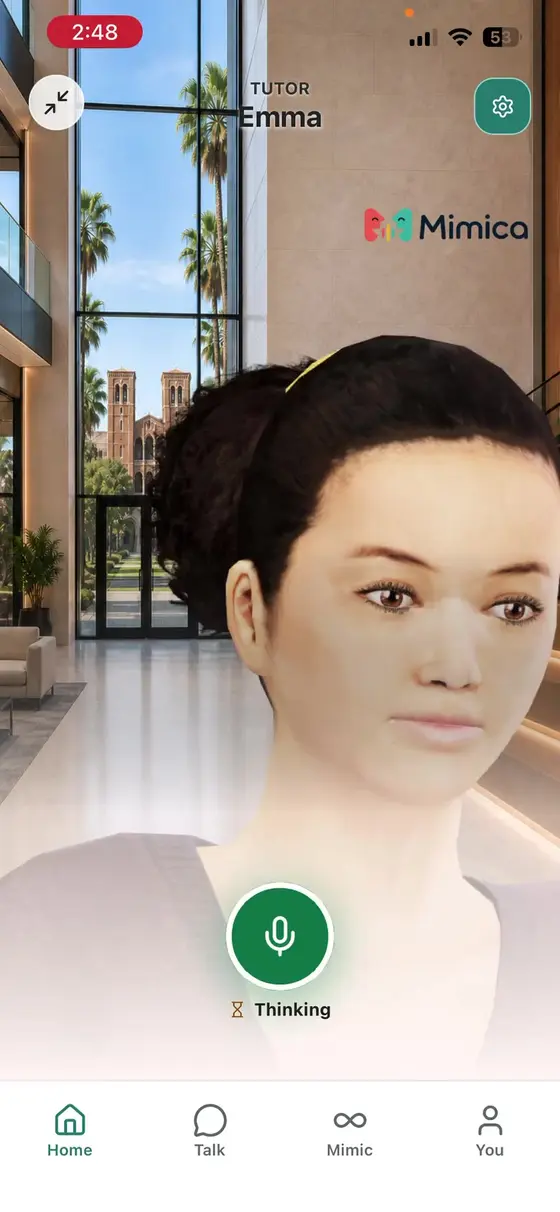
Mimica is an app for iOS and Android where you speak Portuguese out loud with AI tutors and characters. You play roleplay scenes with a goal, such as ordering at a café in São Paulo or getting through a job interview, and the tutor adapts to the level you chose during setup. Mimic practice works phrase by phrase and shows you which sounds shifted. Subtitles and instant translation are there in your own language whenever you need them. The Free plan gives you five minutes of speaking a day.