What is easy
- The alphabet and the spelling. The same letters as English, and the stress is predictable or marked with an accent.
- Shared vocabulary. Informação, cidade, possível, universidade. Words ending in tion, ty and ly usually have a Portuguese twin. Most of the vocabulary is shared with Spanish.
- Você. In Brazil, you takes the same verb form as he and she, so you start with fewer endings than in Spanish.
- Word order. Subject, verb, object, as in English. Questions are made by raising your voice.
- Input. Brazilian music, series and films are everywhere, and Portuguese is spoken on four continents.
What takes time
- The sound. Nasal vowels, open against closed e and o, and unstressed vowels that shrink. European Portuguese goes further and drops them almost completely, so telefone can sound like "tlfon".
- Listening. Brazilian and European Portuguese sound different enough that a learner of one struggles with the other at first.
- Two verb forms almost nobody else has. The personal infinitive, an infinitive with endings, as in para nós falarmos, and the future subjunctive, as in quando você chegar, when you arrive. The second one is used in everyday speech, not only in books.
- Ser, estar and ficar. Three verbs where English has to be, and ficar also means to stay and to become.
- Gender and agreement. Every noun is masculine or feminine, and the articles and adjectives follow it.
- Pronoun placement. Brazil says me diga and Portugal says diga-me. Both are correct, and you have to choose one.
It depends on your first language
- Spanish. The fastest start of any language, and a trap. You can read almost everything from day one, but the sound is different, and many Spanish speakers stay in a mix of the two languages. Portuguese speakers usually understand Spanish more easily than the other way round, because Portuguese has more vowel sounds.
- Italian, French. The grammar is familiar and much of the vocabulary is close. French speakers already have nasal vowels, which helps.
- English, German. The Latin vocabulary helps, and the two unusual verb forms, gender and the nasal vowels are the work.
- Japanese. Brazil has a large community with Japanese roots, and Japan has many Brazilian residents, so input is easy to find. The sounds and the verb endings are new.
How long it takes
The US Foreign Service Institute, which trains diplomats, puts Portuguese in its easiest group for English speakers: about 24 weeks of full-time study, around 600 class hours, to reach professional working proficiency. Everyday conversation comes much sooner, and sooner still for Spanish speakers, as long as they spend the time on listening and speaking rather than reading.
What makes it easier
- Choose Brazilian or European Portuguese at the start and stay with it for the first months.
- Learn the sounds before the grammar. Nasal vowels and open against closed vowels change the meaning of words.
- Repeat whole phrases after a native speaker, so the rhythm comes with the words.
- Speak a few minutes every day. Rhythm is a habit, not a rule.
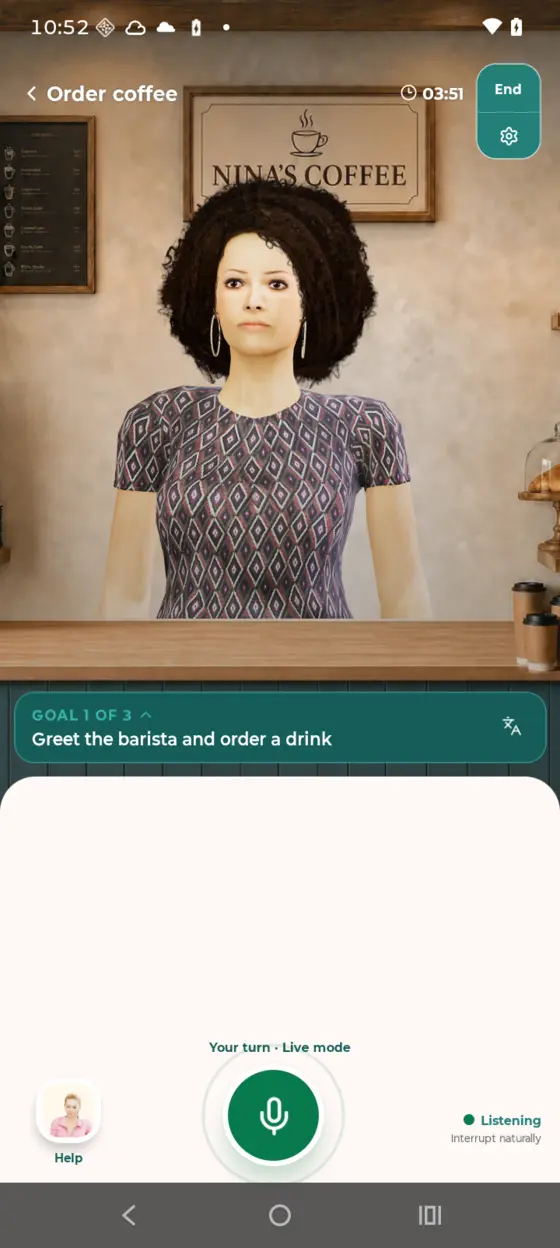
Mimica is an app for iOS and Android where you speak Portuguese out loud with AI tutors and characters. The tutors speak Brazilian Portuguese, the scenes have a goal, such as a café in São Paulo or a job interview, and Mimic practice shows you which sounds shifted, phrase by phrase. Subtitles and translation are there in your own language. See how to learn Portuguese, rhythm first for a first-month plan.