Week 1: the five vowels and the two r sounds
Spanish has five vowels, a, e, i, o and u, and each one is short, clear and always the same. English speakers tend to stretch them and slide into a second sound, so that no becomes "nou". Keep them short and keep your mouth in one position.
There are two r sounds. The single r between vowels, as in pero and caro, is a quick tap of the tongue, close to the tt in the American pronunciation of butter. The double rr, and the r at the start of a word, is a trill, as in perro, carro and Roma. Pero means but and perro means dog, so the difference matters. Practise them as pairs: pero and perro, caro and carro.
A few more rules cover almost everything else. B and v are the same sound. J, and g before e or i, is a rough h, as in jamón and gente. H is silent. Ll and y sound the same for most speakers. Once you know these, you can read any Spanish word aloud correctly.
Week 2: the present tense and a few hundred words
Spanish verbs come in three groups, ending in ar, er and ir. Learn one model for each, hablar, comer and vivir, and you have the pattern for thousands of verbs. Then learn the irregular verbs you will use every day: ser and estar, tener, ir, querer and poder.
Learn ser and estar together from the start. Ser is for what something is: soy chileno, es médica. Estar is for where it is and how it is right now: estoy en casa, estoy cansado. Most mistakes with these two come from learning one before the other.
For vocabulary, work from situations, not from a frequency list: a café, directions, introductions, shopping, numbers and days. Say every new word inside a sentence.
Week 3: questions, and a real conversation
Spanish questions are easy to form. Most of the time you keep the same words and raise your voice at the end: ¿Tienes tiempo? Add the question words qué, dónde, cuándo, cómo, cuánto, por qué and quién, and you can ask for almost anything.
Now speak. Order a coffee, ask for directions, say who you are. Expect to understand less than you can say. Spanish speakers link their words, so ¿Cómo estás? sounds like one word, and the language is spoken at one of the fastest syllable rates measured among major languages. Listening to natural speech from the first week is the only way to get used to it.
Week 4: the past and the future, the simple way
For the future, use ir a plus the verb: voy a comer, vamos a salir. For the past, learn the preterite of the verbs you use most: fui, hablé, comí, tuve. With these two patterns you can talk about yesterday and tomorrow. The other past tenses and the subjunctive can wait until you are already having conversations.
Choose one variety and stay with it at first
Spanish from Spain uses vosotros for you in the plural and pronounces c before e or i, and z, with a sound like the English th. Latin America uses ustedes and pronounces those letters as s. Argentina and Uruguay use vos instead of tú and say ll and y with a sound close to sh. Everyone understands everyone. Choose the variety of the people you will talk to, and learn that one first.
A daily routine that fits in five minutes
- One sound for the week. Start with the two r sounds and the vowels.
- One short drill. A few phrases built around that sound. Say them, listen to what shifted, say them again.
- One short scene. Order the coffee or ask the way. One goal, one conversation.
- Every day. Five minutes a day does more than an hour on Sunday, because the sounds have to be repeated while they are still fresh.
How Mimica fits this plan
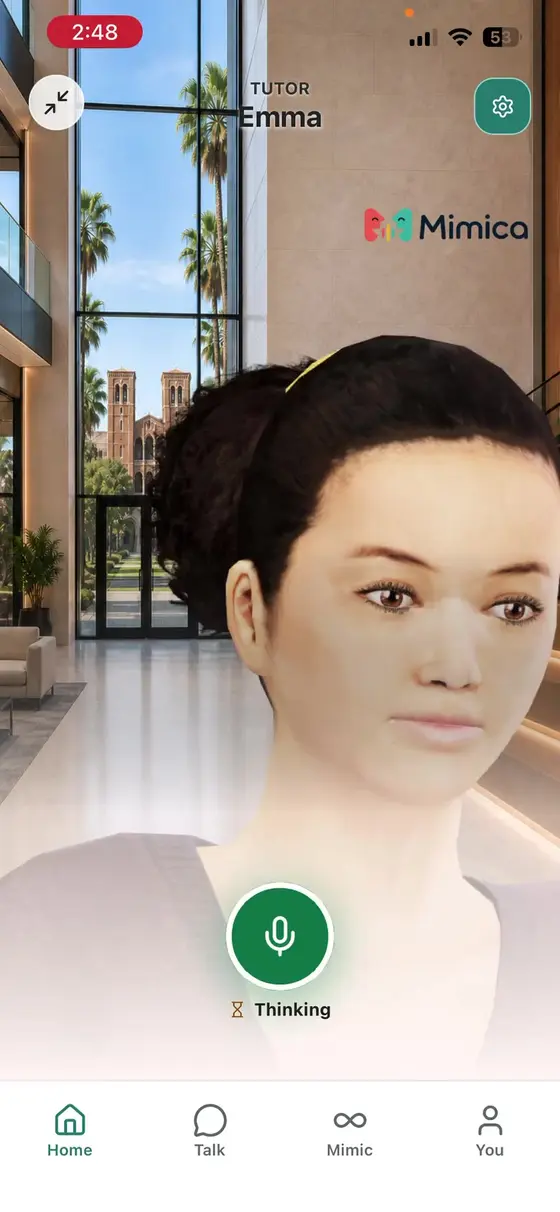
Mimica is an app for iOS and Android where you speak Spanish out loud with AI tutors and characters. You play roleplay scenes with a goal, such as ordering at a café in Madrid or asking for directions in Mexico City, and the tutor adapts to the level you chose during setup. Mimic practice works phrase by phrase and shows you which sounds shifted. Subtitles and instant translation are there in your own language from the first minute. The Free plan gives you five minutes of speaking a day.