What is easy
- Spelling. Once you know the rules, you can read any Spanish word aloud correctly. The stress is predictable, and when it is not, a written accent tells you where it goes.
- Five vowels. A, e, i, o and u, each one always the same sound. English has around twenty.
- Shared vocabulary. Thousands of words are the same or almost the same: information and información, university and universidad, possible and posible. Words ending in tion, ty and ly usually have a Spanish twin.
- Questions. Keep the words and raise your voice at the end.
- Input everywhere. Music, series and films in Spanish are easy to find, and about five hundred million people speak it as a first language, in more than twenty countries.
What takes time
- Speed and linking. Spanish is spoken at one of the fastest syllable rates measured among major languages, and words run together. Learners can usually speak before they can follow a conversation between natives.
- Verbs. Every tense has six endings, there are more than a dozen tenses, and the most frequent verbs are irregular. The subjunctive is used every day, as in quiero que vengas.
- Ser and estar, por and para. Two words where English has one. The rules are learnable, but choosing the right one at speed takes practice.
- Gender and agreement. La casa blanca, el coche blanco. Every noun has a gender, and the adjectives follow it.
- The two r sounds. The trill in perro and the tap in pero are different words, and the trill takes some weeks of practice for most English speakers.
- Regional differences. A car is coche in Spain, carro in Mexico and auto in Argentina. Everyone understands everyone, but you will notice the differences.
It depends on your first language
- Portuguese, Italian, French, Romanian. The grammar is familiar and most of the vocabulary is shared. The work is in the sounds and in not mixing the languages.
- English, German, Dutch. The Latin vocabulary helps. The verb system, gender and the trill are the new parts.
- Japanese. The five vowels are very close to Japanese vowels, which makes Spanish unusually easy to pronounce. The verb endings and gender are new.
- Chinese, Korean, Arabic. The vowels are manageable. Verb endings, gender and agreement take the most time, and Arabic speakers work on p against b.
How long it takes
The US Foreign Service Institute, which trains diplomats, puts Spanish in its easiest group for English speakers: about 24 weeks of full-time study, around 600 class hours, to reach professional working proficiency. Everyday conversation comes much sooner. What matters most is how many of your hours are spent speaking rather than reading.
What makes it easier
- Learn the sounds in the first week. The spelling will then do the rest.
- Learn ser and estar together, with one example sentence each.
- Start with the present tense and a few hundred words from real situations, and speak from day one.
- Pick one variety, from Spain, Mexico or Argentina for example, and learn that one first.
- Practise a few minutes every day. A trill is a muscle movement, and it needs repetition more than explanation.
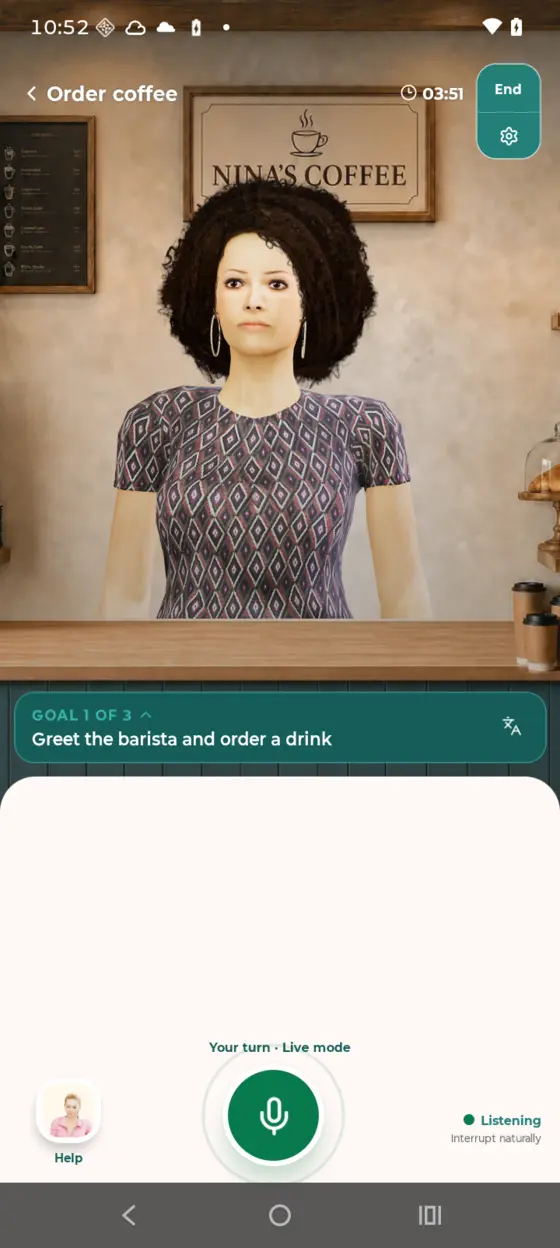
Mimica is an app for iOS and Android where you speak Spanish out loud with AI tutors and characters, play scenes with a goal, such as a café in Madrid or directions in Mexico City, and drill pronunciation phrase by phrase. The tutor adapts to your level and subtitles and translation are there in your own language. See a speaking plan for the first month.