What is easy
- The sounds. Five vowels, close to Spanish, and syllables made of one consonant and one vowel. There are no consonant clusters and no th or v.
- No gender, no plural, no articles. Hon is a book, the book, books and the books. Context does the rest.
- Regular verbs. Verbs do not change for the person, there are only two tenses, past and non-past, and only two verbs are truly irregular, suru and kuru.
- Questions. Add ka at the end of the sentence.
- Loanwords. Thousands of everyday words come from English and are written in katakana: terebi, television, and konpyūtā, computer.
What takes time
- Writing. Three scripts used together. Hiragana and katakana take two weeks. The 2,136 jōyō kanji, each with more than one reading, take years. Reading a newspaper is a long-term goal, not a first-year one.
- Politeness levels. The plain form with friends, the masu form with most people, and keigo, with separate respectful and humble verbs, with customers and superiors. Choosing the level on the spot takes practice.
- Word order. The verb comes last, and descriptions come before the noun they describe. You do not know whether a sentence is negative or in the past until the final syllables.
- Particles. Wa against ga is a question learners ask for years. The others are learned with practice.
- Counters. Flat things, long things, small animals and people each take a different counting word.
- Vowel length and pitch. Obasan is an aunt and obāsan is a grandmother. Hashi is chopsticks or bridge depending on the pitch. The differences are small to a foreign ear and clear to a Japanese one.
- Vocabulary. Apart from the loanwords, almost nothing is shared with European languages.
It depends on your first language
- Korean. The grammar is almost parallel, with the verb last, particles and honorifics, and many words of Chinese origin are shared. Korean speakers learn Japanese faster than anyone else.
- Chinese. The kanji are familiar, which removes the biggest obstacle. The readings, the grammar and the politeness levels are new.
- Spanish, Italian, Portuguese. The vowels are almost the same, so pronunciation comes fast. Everything else is new.
- English, French, German. The sounds are the one easy part. Writing, word order and politeness levels take the time.
How long it takes
The US Foreign Service Institute, which trains diplomats, puts Japanese in its most demanding group for English speakers: about 88 weeks of full-time study, around 2,200 class hours, to reach professional working proficiency, including reading. Everyday conversation comes much sooner, especially if you spend your early hours speaking rather than on kanji.
What makes it easier
- Speak from the first weeks in the masu form. It is polite, regular and never wrong with a stranger.
- Learn hiragana and katakana early and leave kanji until you can hold a conversation.
- Learn particles inside phrases you say, not from a table.
- Copy the melody of a native speaker for pitch and vowel length, rather than studying the rules.
- Practise a few minutes every day. Vowel length is a habit of the ear.
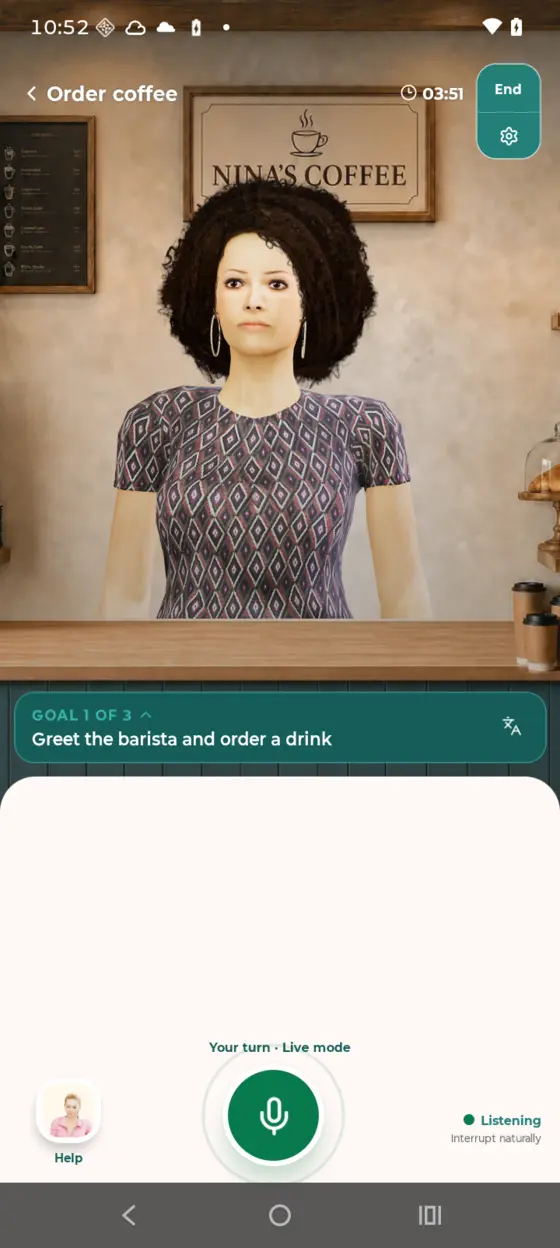
Mimica is an app for iOS and Android where you speak Japanese out loud with AI tutors and characters. The tutor speaks first and waits for you, the scenes have a goal, such as a Tokyo café or a front-desk conversation, and Mimic practice shows you which sounds shifted, phrase by phrase. Subtitles and translation are there in your own language. See how to learn Japanese, polite form first for a first-month plan.